
Heinali & Andriana – Yaroslava Saienko (UKR)
"Гільдеґарда" (“Hildegard” in Ukrainian) is a unique reinterpretation of Hildegard of Bingen’s music. The project combines the vocal techniques of authentic Ukrainian folk singing with modular synthesis techniques inspired by the polyphony and monophony of the High Middle Ages. Developed by Heinali, an electronic music composer whose work expands the traditions of Western medieval music through modular synthesis, and Andriana-Yaroslava Saienko, a singer dedicated to preserving authentic Ukrainian vocal traditions, the approach brings out the physicality inherent in Hildegard’s visionary music. At the same time, it serves as a distant mirror through which experiences of war can be reflected upon, understood, processed, and ultimately overcome.
Artist
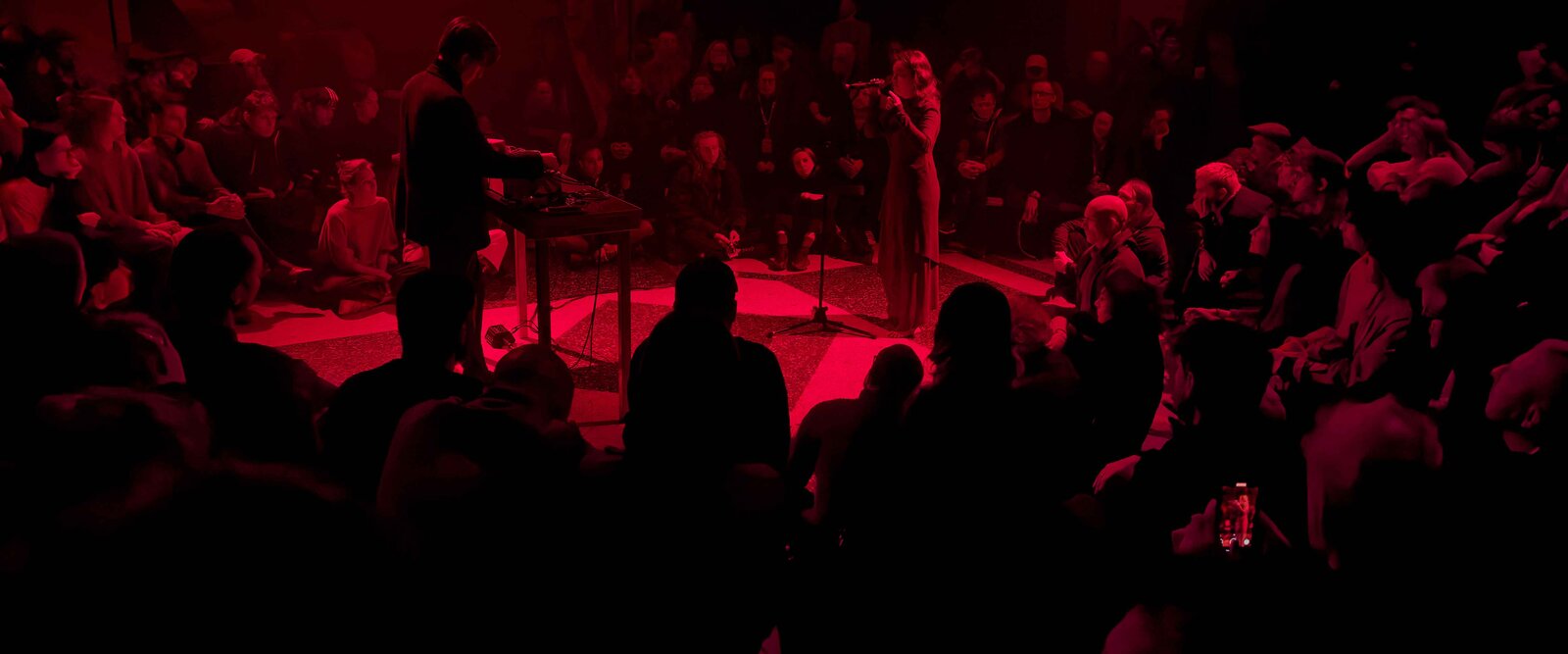
Heinali & Andriana – Yaroslava Saienko (UKR)
"When a Russian missile struck near my studio in Kyiv, my body reacted to the explosion milliseconds before my mind did," recalls composer and electronic musician Oleh Shpudeiko, aka Heinali. "That traumatic explosion sent something deep inside me into a primordial state. There was nothing but fear—the kind of fear described in Scripture when angels appear and proclaim: Do not be afraid."
What does this have to do with the music of Hildegard of Bingen, which Heinali reinterprets together with singer Andriana-Yaroslava Saienko? The visions of the 12th-century abbess, composer, and mystic Hildegard were likewise preceded by bright, painful flashes of light. Modern medicine attributes them to cluster migraines, whose symptoms can include visual auras, often accompanied by blurred vision and blind spots. "Hildegard's music can place considerable demands on the bodies of its performers, emphasizing dissonant intervals and the vast range between the lowest and highest pitches. By comparison, Gregorian chant, the liturgical standard of the time, represents a more moderate attempt to grasp God intellectually; indeed, Hildegard's music has been described as a stick of dynamite thrown into a Gregorian chant."
Location
-
Universitätsplatz 1
-
-
-